SLAMWOW
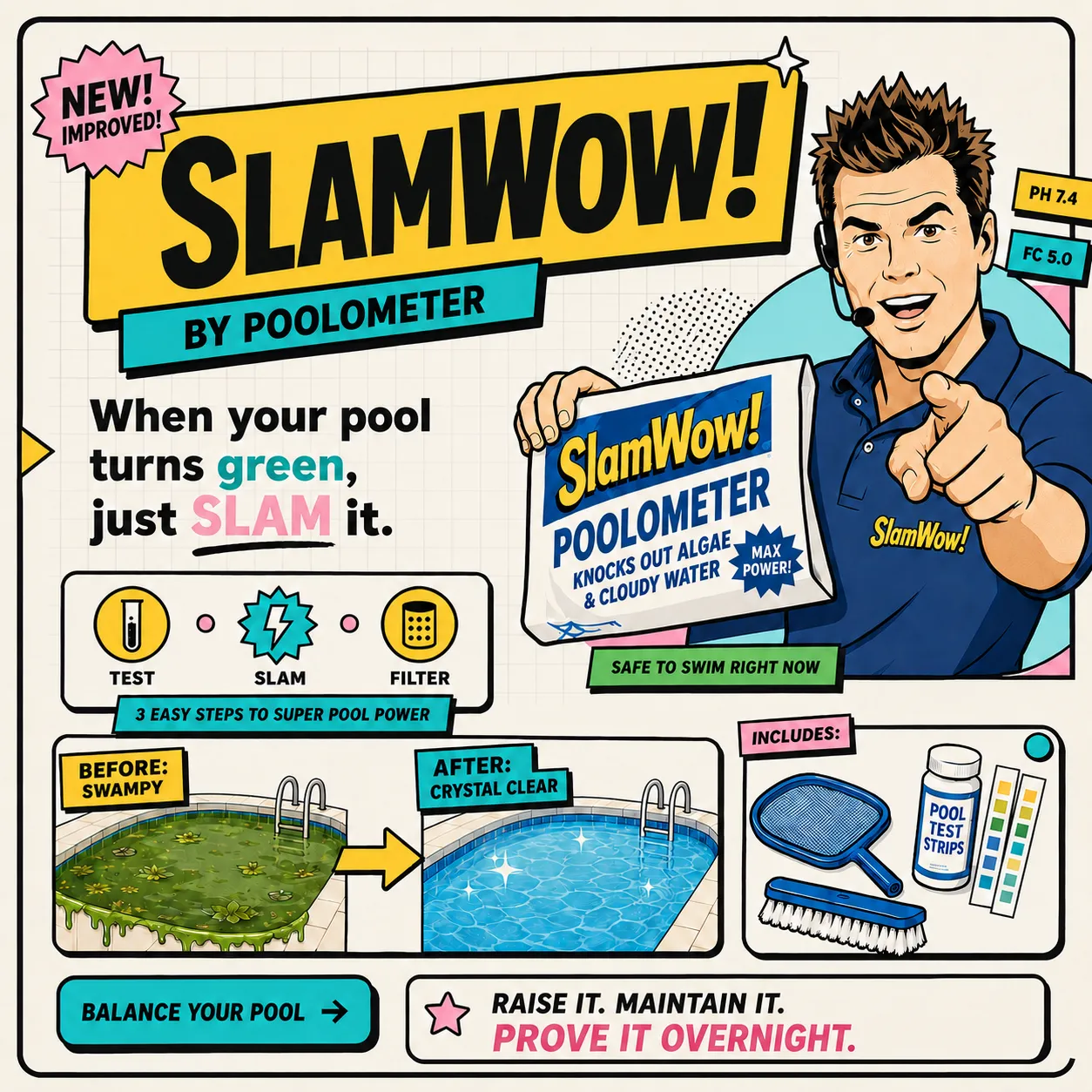
The pitch
This is not dump-and-hope shock.
It's like shock, it's like science, it's like a pool-cleaning boot camp.
A regular shock says, "Dump it in and hope."
SLAMWOW says, "Test it, raise it, maintain it, prove it."
The promise
Not magic. Testing, chlorine, brushing, filtering, patience.
This is for the pool that needs a real reset.
The green pool.
The cloudy pool.
The vacation-soup pool.
The pool where the ladder is growing fur.
The pool where you say, "I shocked it three times!" and the algae says, "That's cute."
Know the numbers
FC, CC, and CYA tell you what to do next.
You do not guess the shock level. You match it to the stabilizer.
- FC
Free chlorine
The good chlorine still ready to work.
- CC
Combined chlorine
Used-up chlorine telling you it has been fighting something.
- CYA
Stabilizer
Helpful in the sun, but too much means chlorine needs a higher target.
Common SLAM targets
Check your actual CYA and use the app calculator when the number is not one of these.
30 CYA
Around 12 FC
40 CYA
Around 16 FC
50 CYA
Around 20 FC
Before chlorine goes high
Use a FAS-DPD kit
Not a strip from a drawer. SLAM chlorine levels get high, and you need numbers that hold up.
Before chlorine goes high
Fix pH first
Bring pH around 7.2 to 7.5 before high chlorine makes the pH test act like it is in witness protection.
Before chlorine goes high
Use liquid chlorine
Sodium hypochlorite is fast and direct. No added CYA. No added calcium. It just does the work.
Read the label
Some chlorine products bring extras with them.
Trichlor tabs
They add CYA. That can push the target higher while you are trying to clear the pool.
Dichlor shock
It adds CYA too. Repeating it can make the job harder.
Cal-hypo
Maybe fine, but check calcium because it brings calcium to the party.
Splashless laundry bleach
Absolutely not. Use plain chlorine only.
The cadence
Test. Dose. Brush. Filter. Repeat.
You do not let chlorine drop and say, "Well, I shocked it yesterday." You test again. You dose again. You maintain.
- 1Test FC.
- 2Add enough liquid chlorine to hit shock level.
- 3Keep the pump on.
- 4Brush walls, steps, ladders, and light niches.
- 5Vacuum the bottom.
- 6Clean the filter when pressure or flow tells you it is loading up.
Algae on the walls, dead algae in the filter, and cloudy water can make it look like nothing is happening. The chlorine is doing the work.
On day one, check every couple hours if you can. Later, chlorine holds longer. That is how you know you are winning.
Blue-cloudy is not done. Blue-cloudy means keep going. You want crystal.
The finish line
Three tests. Count them.
Not better. Not pretty good. Done means the pool passes all three.
1
Water is crystal clear
You can see the deep end and the pool does not hide haze.
2
CC is 0.5 or lower
The used-up chlorine signal is quiet.
3
Overnight loss is 1 ppm or less
Test after sunset and before sunrise. No sun, no excuses.
What not to buy
Stop stacking bottles when the process is not finished.
Random shock, clarifier, algaecide, phosphate remover, and magic blue sparkle juice do not replace chlorine, testing, brushing, filtering, and patience.
This works for vinyl, plaster, fiberglass, and salt pools. Salt pools are chlorine pools; the cell just makes chlorine slower than a SLAM needs it.
Safety matters
Clean the pool. Do not create a garage volcano.
- Do not mix chlorine and acid.
- Do not mix different chlorines.
- Do not use the same scoop for cal-hypo and trichlor.
- Do not add water to chemicals. Add chemicals to water.
- Wear gloves and eye protection.
- Store chemicals dry, cool, separate, and labeled.
One pause
Clear green water may be metal, not algae.
If the water is clear green instead of cloudy green, test for copper or iron before you SLAM. Algae gets SLAMmed. Metals need a metal plan.
Call now? No.
Test now.
Get your FAS-DPD kit, your CYA number, liquid chlorine, brush, and clean filter. Raise it. Maintain it. Prove it overnight.
SLAMWOW: it is not a product. It is a process.
Educational guidance only. Verify labels, manuals, local code, and site conditions before acting. Stop for electrical, gas, structural, drain, drowning, injury, emergency, or chemical-mixing risk.